
Cahokia: The Rise and Fall of North America’s first City.
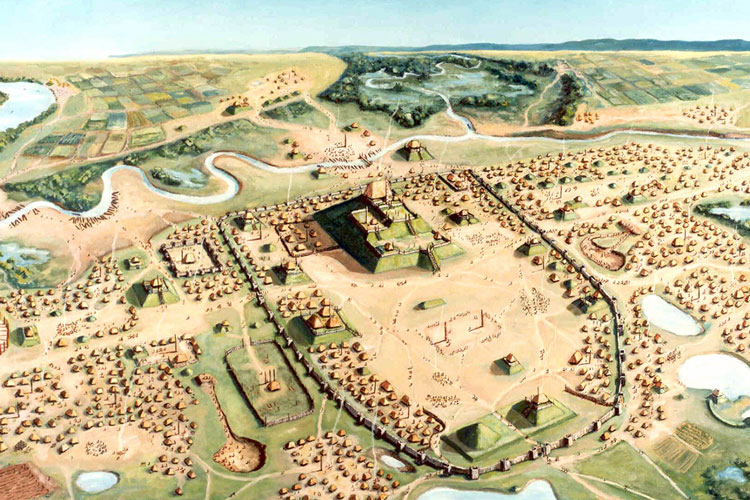
These 360 panoramas were taken from the base and top of Monks Mound, the largest mound at Cahokia, which overlooks the city and central plaza. Look for the other mounds around the plaza and compare to the reconstruction below.
Just east of modern-day St. Louis, Missouri, across the Mississippi River in what is now Illinois lie the ruins of the once powerful Native American city of Cahokia. The city was once the cultural, religious, and economic center of the Mississippian Culture. At its peak, between 1050 and 1150 CE, Cahokia had a population estimated at 40,000 people or more, which made it larger than London or Paris at the time. It remained the largest city in North America until Philadelphia reached that size in the 1780s.
The Rise of the Mississippian World and the origins of Cahokia
The Mississippian Culture was an advanced society that began to develop around 1000 CE across the central and southeastern regions of the current United States. Earlier populations in the area frequently consisted of small settlements of 50 – 100 individuals. By the end of the 10th century many of these communities had aggregated into larger groups.
Communities began to gather near the confluence of the Mississippi, Illinois, and Missouri Rivers in a place ideal for trade, agriculture, and transportation. Around the year 1050 CE this community experienced a “Big Bang” of construction and population growth, fueled in part by immigration as indicated by the wide variety of non-local pottery styles found at the site.
The city was carefully planned on an ordered grid aligned with cosmological principles including a strong emphasis on the cardinal directions. At its core was a grand plaza covering 50 acres (20 ha). There were residential zones with standardized building types clustered around smaller plazas and as many as 120 earthen mounds over an area of 6 square miles (16 km²). Constructing this network of mounds took decades and 55 million cubic feet (1,600,000 m²) of earth which was transported in woven baskets. The mounds had different purposes: some were platforms for elite residences or temples, some were for ceremonial purposes, and some were burial mounds.
Human Sacrifice and Power Made of Earth
The largest of the mounds at Cahokia is Monks Mound, named after Trappist monks who lived on the mound during the colonial period. This is the largest prehistoric earthwork in the Americas and stands around 100 feet (30 m) high and covers just under 14 acres (5.6 ha). It consists of four terraces and contains about 814,000 cubic yards (622,000 m²) of earth. A large building stood at the top of Monks Mound. This was likely a temple or the residence of the paramount chief and was 105 feet in length (32 m) and may have stood as tall as 50 feet (15 m). This would have been visible across the city as a powerful symbol of authority.
Mound 72 is a ridge-top burial mound that contained the bodies of around 270 people. This included 4 men missing their heads and hands, a mass grave of 50 women, and the body of a man buried with important grave goods and placed on a bed of 10,000 marine shells. There were also 40 men and women, most of whom had been violently killed, but some were still alive when buried and their skeletons preserve their last act of clawing at the walls of the trench.
Farming, Craft, and Trade at Cahokia
Cahokia was surrounded by rich agricultural lands and farmers grew a variety of crops. The most important was maize (corn), which was introduced to the region around 900 CE. The city was also a major center of craft production including pottery ranging from utilitarian storage jars to finely crafted ritual vessels. Skilled artisans worked shell, stone, and clay into figurines and ceremonial objects depicting symbols, human figures, and mythical beings reflecting Mississippian cosmology and spiritual beliefs. Archaeologists have also excavated a copper-processing workshop using copper sourced from the Great Lakes, an indication of the extent of Cahokia’s trade network.
Goods, people, and ideas travelled along a vast network of rivers that reached from the Gulf of Mexico in the south to the Great Lakes in the north. The people of Cahokia used Yellowstone obsidian for making tools, had access to trade goods from what is now Pennsylvania, and made ceremonial items and adornments from shells traded from distant coastal areas. The people of Cahokia also established outposts, such as Aztalan and Trempealeau, both in Wisconsin and both with mounds. Smaller versions of those at Cahokia.
The Decline and Legacy of Cahokia
Cahokia began to decline around 1250 CE and was largely abandoned a century later. The reasons for its fall remain debated. Some scholars propose that the agricultural soil around the city may have been depleted from intensive farming, others suggest that the changing climate at the time was a cause. Some theories point to possible internal political problems or an invasion by outside people. Evidence of possible threats include a 2-mile long (3.2 km) palisade equipped with defensive bastions that was built around the high-status central core of the city, Whatever the cause, people not only abandoned the city but also the surrounding region resulting in what scholars call “the Vacant Quarter”.
The civilization of Cahokia didn’t disappear with the city and descendants can be found in many modern Native American tribes. The original name of the city is unknown, but comes from the Cahokia, one of these later tribes. The mounds also remained visible on the landscape and St. Louis was once known as “Mound City” before almost all of the mounds in that area where demolished to use as fill during urban expansion.
The area became farmland until the site gained some protection as an Illinois state park. Highway expansion in the 1940s threatened more damage to the site, but in 1982 preservation efforts succeeded in Cahokia being designed a UNESCO World Heritage Site.
Today, Cahokia is open to visitors. Many of the trails are wheelchair accessible and the museum has been designed to avoid damage to the archaeology. Reaching the summit of Monks Mound requires climbing 156 steps, but the view from the top captures the scale of the ancient city and offers a powerful reminder that North America’s past is deeper and more complex than most people realize.